

The Real Cost of Running a Red Light: What You Need to Know
How much is a red light ticket varies significantly depending on your state and whether it was issued by a camera or an officer. Here’s a quick breakdown:
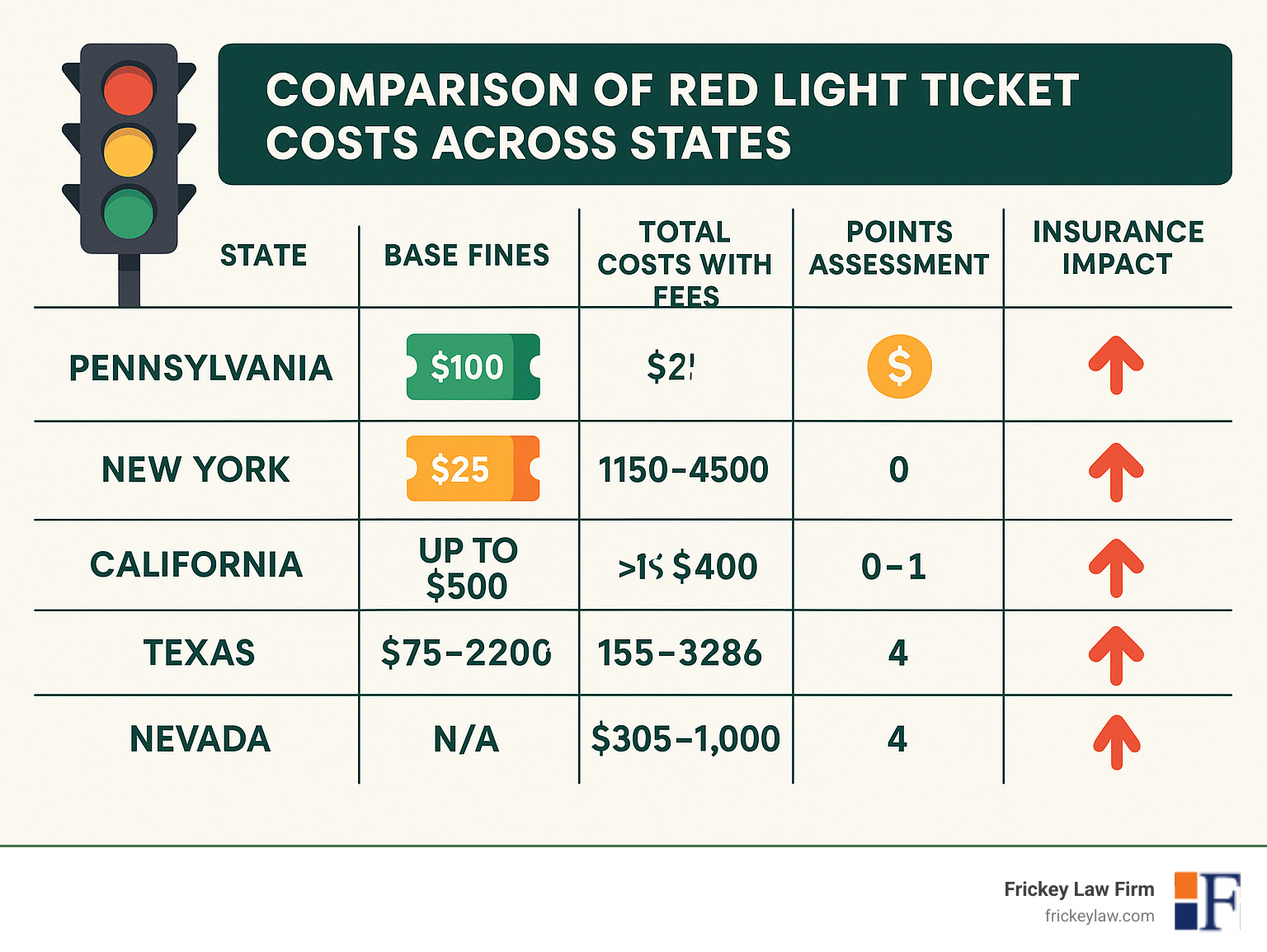
| State | Camera Ticket | Officer Ticket | Points |
|---|---|---|---|
| Pennsylvania | $100 | $25 + court costs | 0 for camera, 3 for officer |
| New York | $50 | $150-$450 | 0 for camera, 3 for officer |
| California | Up to $500 | $100 + fees (over $400) | 0-1 depending on type |
| Texas | $75-$200 | $155-$286 | Varies by city |
| Nevada | N/A | $305-$1,000 | 4 points |
Running a red light isn’t just dangerous—it can be expensive. Those flashing lights in your rearview mirror or that unexpected envelope in your mail can lead to fines ranging from $50 to over $1,000 depending on your location.
Red light camera tickets typically don’t add points to your license or affect insurance rates, while officer-issued tickets often do both. This distinction can mean the difference between a simple fine and years of increased insurance premiums.
I’m Michael Frickey, a Board Certified Specialist in Criminal Law who has handled hundreds of how much is a red light ticket cases throughout North Carolina, helping clients understand their options and minimize financial impact. As the founder of Frickey Law, I’ve seen how proper legal guidance can transform these situations from costly headaches into manageable experiences.
How much is a red light ticket? State-by-State Cost Breakdown
That sinking feeling when you see a camera flash or red and blue lights in your rearview mirror is universal, but the hit to your wallet varies dramatically depending on your zip code. When it comes to answering how much is a red light ticket, there’s no one-size-fits-all answer – your location makes all the difference.
National averages: how much is a red light ticket?
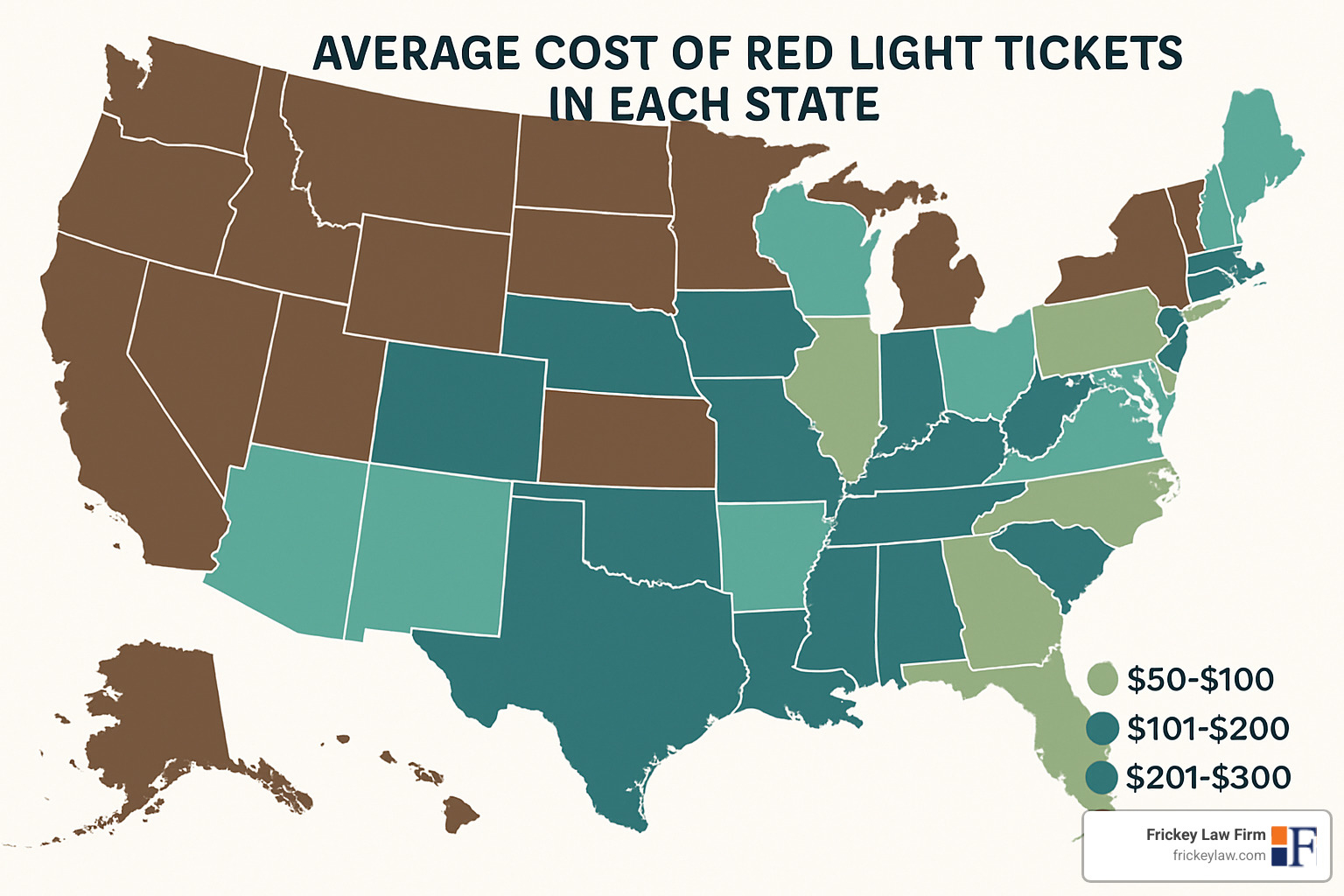
Across America, how much is a red light ticket typically falls between $50 and $500 for the base fine alone. But here’s where things get tricky – that initial number is often just the beginning of your financial journey.
Think of the base fine as the tip of the iceberg. Lurking beneath the surface are court costs that can add $50-$100, administrative processing fees adding another $15-$30, and various public safety surcharges tacking on $25-$50 more. That seemingly manageable $100 ticket can quickly balloon to $250 or more before you even realize what happened.
And we haven’t even talked about the potential long-term costs yet (like those insurance premium hikes that might haunt you for years to come).
State snapshots: how much is a red light ticket in your area?
Let’s take a road trip across America to see how these costs vary:
In Pennsylvania, there’s a fascinating flip-flop in the system. Camera tickets cost more upfront (around $100) but add zero points to your license. Get caught by an officer, though, and while you’ll pay only $25 in base fines, those 3 points on your license might cost you much more through insurance increases.
New Yorkers face a similar dynamic. How much is a red light ticket in the Empire State? Camera tickets are a straightforward $50 with no points – similar to a parking ticket. But if an officer writes you up, you’re looking at $150-$450 (with higher costs in NYC and for repeat offenders), plus 3 license points that can drive up insurance rates.
Heading west to California, prepare for sticker shock. While the base fine might start around $100, the actual amount you’ll pay after all the assessments and fees can rocket past $500. Some jurisdictions even throw in mandatory traffic school as a bonus (lucky you!).
In the Lone Star State, Texas cities set their own rates. Houston residents pay around $155, while Austin drivers shell out closer to $286. Each violation adds 2 points to your license (or 3 if you caused an accident).
Nevada takes red light violations especially seriously, classifying them as misdemeanors rather than simple infractions. This legal distinction means fines between $305 and $1,000, plus 4 points on your license. Nevada courts can even impose jail time of up to six months – though that’s rare for first-time offenders.
In Delaware, camera violations start at $110, but procrastinators beware – that amount can jump to $140 if you don’t pay promptly.
As you can see, the answer to how much is a red light ticket isn’t just state-specific – it’s a complex calculation based on whether a camera or officer caught you, your driving history, and even which city you’re driving through.
Red Light Camera vs Officer Ticket: Points, Insurance & Penalties
The source of your ticket—camera or officer—can make a tremendous difference in both immediate costs and long-term consequences.
Do red light camera tickets add points or raise insurance?
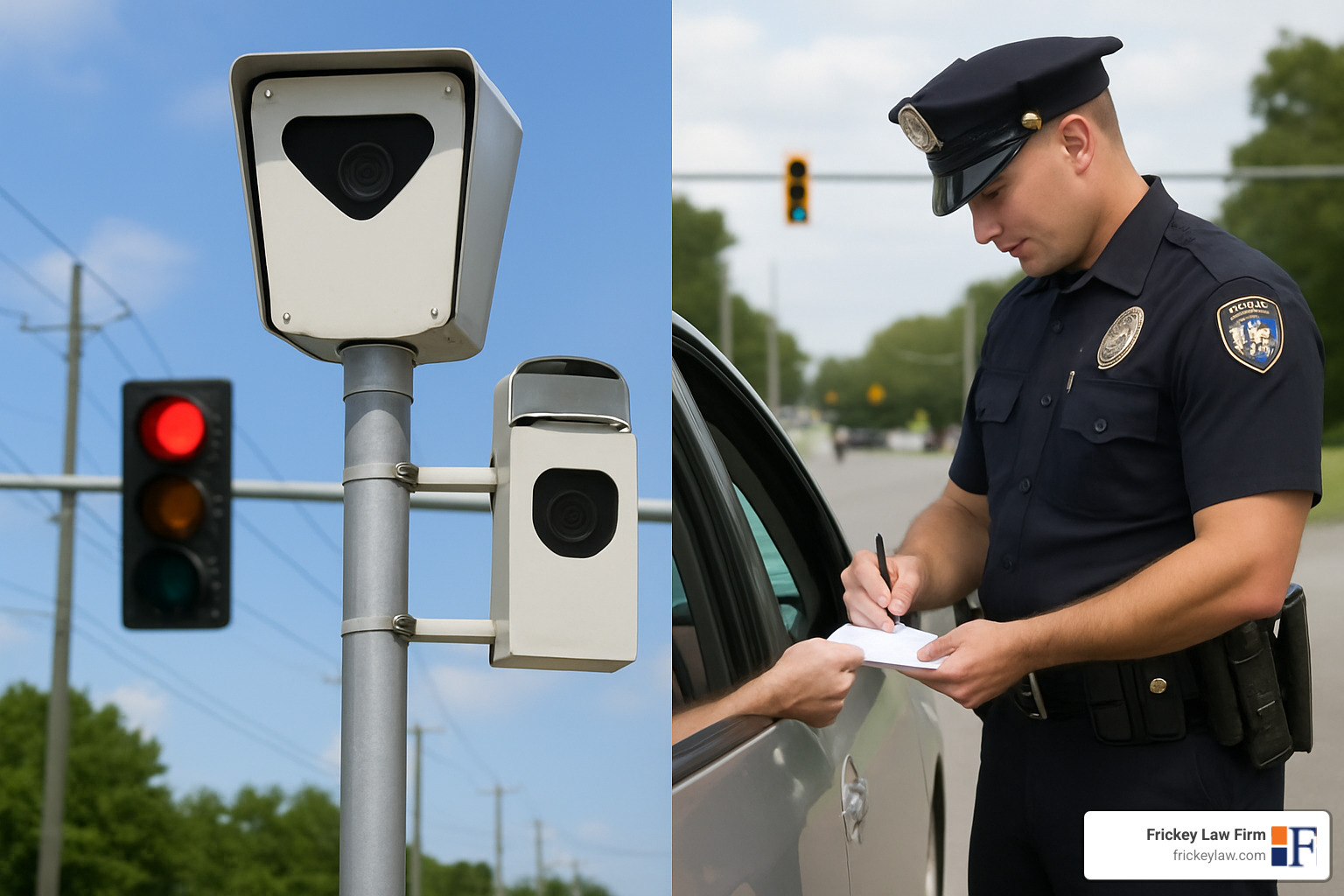
Good news if you’ve received a camera ticket in your mailbox! In most states, these automated citations are treated as civil violations rather than moving violations—and this distinction makes all the difference for your wallet and driving record.
Think of red light camera tickets as distant cousins to parking tickets. They’re typically issued to whoever owns the vehicle, not necessarily the person behind the wheel. This means zero points on your license in most jurisdictions. Your driving record stays clean, and what your insurance company doesn’t know won’t hurt your rates!
These tickets operate under civil enforcement rules, so the consequences are usually limited to the fine itself. In Pennsylvania, New York, and Maryland, the law explicitly prevents these tickets from adding points to your license or being used against you for insurance purposes. In NYC, for example, those $50 camera tickets go to the registered owner regardless of who was actually driving.
But don’t get too comfortable—there are exceptions. Some places have special rules for repeat offenders. In New York, if you rack up five or more camera violations within a year, you might find yourself completing a mandatory safe driving course or, in extreme cases, watching your vehicle get impounded. Not exactly how most of us want to spend our weekend!
Officer-issued tickets: why the same light can cost you more
When those red and blue lights flash in your rearview mirror after running a red light, brace yourself—the consequences are typically more severe than a camera ticket.
How much is a red light ticket from an officer? It’s not just about the upfront cost. Officer-issued tickets are classified as moving violations that add points to your driving record—3 points in Pennsylvania, 1 point in California, and a whopping 4 points in Nevada. Those points aren’t just numbers; they’re like little financial time bombs for your insurance rates.
A single moving violation can trigger insurance premium increases of 20-30%, and these hikes often stick around for 3-5 years. Do the math, and you’ll see that a $200 ticket could actually cost you thousands over time. Ouch!
The consequences don’t stop there. Accumulate too many points, and your license could be suspended. In Pennsylvania, hitting 6 points means you’ll need to pass a written exam, while 11 points leads to automatic suspension. In Nevada, red light violations are actually classified as misdemeanors rather than simple infractions—potentially carrying jail time. That’s right, jail time for running a red light!
Despite these harsh penalties, there’s good reason for enforcement. Research by the Insurance Institute for Highway Safety has shown that red light cameras have contributed to a 21% reduction in fatal red light running crashes in large cities and a 14% reduction in all fatal crashes at signalized intersections. Safety first, but your wallet might prefer the camera ticket if you had to choose.
The best ticket is the one you never get—by stopping safely when the light turns yellow!
Resolving Your Ticket: Payment, Deadlines & Defense Strategies
Once that dreaded red light ticket arrives in your mailbox or on your windshield, don’t panic. You’ve got options, and knowing how to steer them can save you time, money, and stress.
Step-by-step: from notice to paid (or dismissed)
First things first—take a deep breath and look closely at your ticket. Different cities use different coding systems. In Philadelphia, for example, a ticket with an “RL” prefix is handled completely differently than one with a “536” prefix. This small detail can make a big difference in how you proceed.
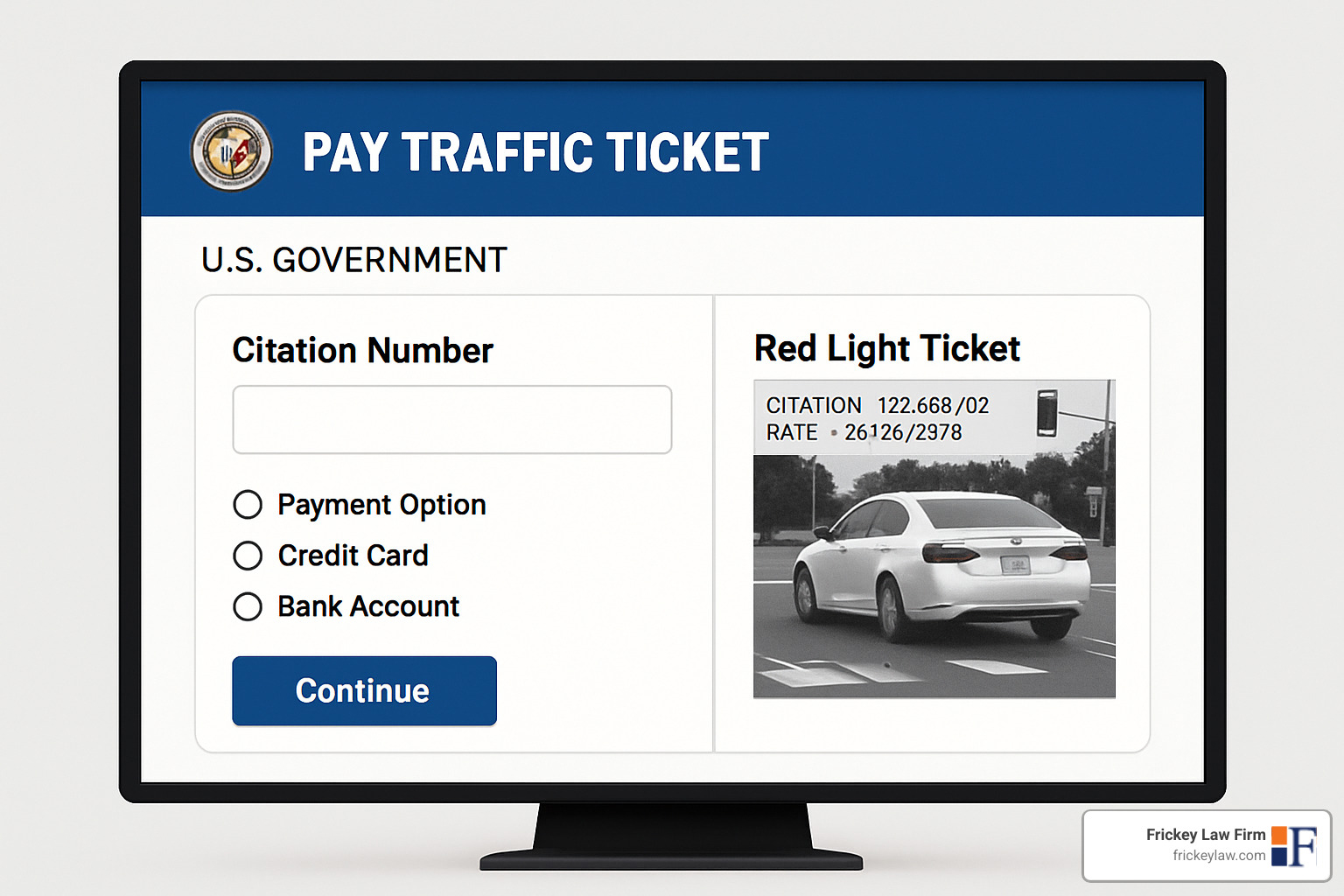
Next, review the evidence. Most how much is a red light ticket notices include a way to access photos or video of the alleged violation. Use the citation number and PIN provided to check out exactly what they claim you did. Sometimes what you see might surprise you—and give you grounds to contest the ticket.
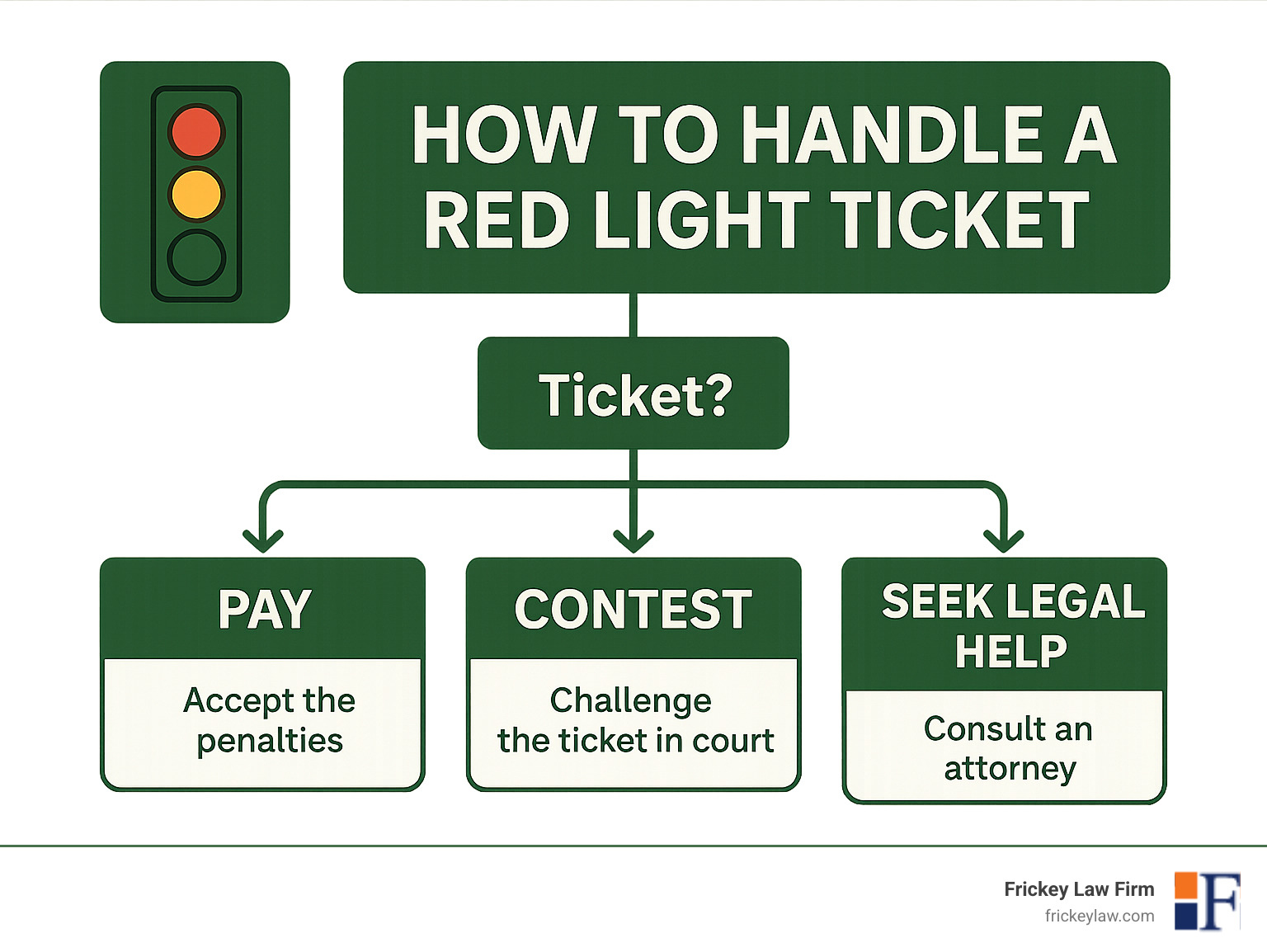
Now comes decision time. You’ve generally got three paths forward: pay up and accept any consequences, fight the ticket at a hearing, or in some jurisdictions, take a defensive driving course to reduce the financial sting. Each option has its merits depending on your situation and the strength of your case.
Watch that calendar! Most jurisdictions give you just 30 days to respond. Miss that window, and you could face late fees of $10-$25 or more—and eventually, collection actions or holds on your vehicle registration. That original how much is a red light ticket amount can balloon quickly if ignored.
Ready to pay? Most places offer multiple payment methods to make it relatively painless. Online payments are usually quickest but might include a small processing fee. You can also mail a check (never cash!), pay by phone with a credit card, or visit a payment center in person if you prefer the face-to-face approach.
If you’re leaning toward contesting the ticket, request that hearing within the same 30-day timeframe. The good news? Many courts now offer virtual hearings via Zoom or similar platforms, so you might not even need to take time off work to make your case.
Common defenses that win
Not all tickets are created equal, and some can absolutely be beaten with the right approach. At Frickey Law Firm, we’ve seen several defenses work consistently well for our clients.
Faded stop lines can be your friend in court. If the line where you were supposed to stop was worn away or poorly marked, how could you know exactly where to halt? Philadelphia drivers have reported success with this defense when they could prove the markings were unclear.
Emergency situations sometimes force even the most careful drivers through red lights. Whether you needed to make way for an ambulance or avoid a collision, these extenuating circumstances can form a valid defense. Courts generally understand that safety sometimes trumps strict adherence to signals.
Camera malfunctions happen more often than you might think. These devices require regular calibration and maintenance, and requesting certification records can sometimes reveal that the camera that caught you wasn’t up to standard. Technical glitches have voided many a ticket.
Vehicle misidentification is another common issue. In the split second a camera captures an image, it might record the wrong license plate or misidentify a similar-looking vehicle. Always scrutinize those photos carefully—the car in question might not even be yours!
If someone else was driving your car when the violation occurred, you might be able to file an affidavit identifying the actual driver. In Delaware, for instance, vehicle owners can submit notarized statements shifting responsibility, though you’ll still be on the hook if the identified driver doesn’t pay up.
The reality is that how much is a red light ticket matters less if you can get it dismissed entirely. At Frickey Law Firm, we’ve helped countless clients successfully contest these citations by spotting technical issues or presenting compelling evidence that changes the narrative.
Paying without question isn’t your only option. With the right approach—and sometimes the right legal help—you can steer this process with minimal impact on your wallet and driving record. Save Money on Traffic Tickets by understanding all your options before making a decision.
How Red Light Cameras Work, Locations & Legal Landscape
Understanding how red light cameras operate can help you both avoid violations and contest them if necessary.
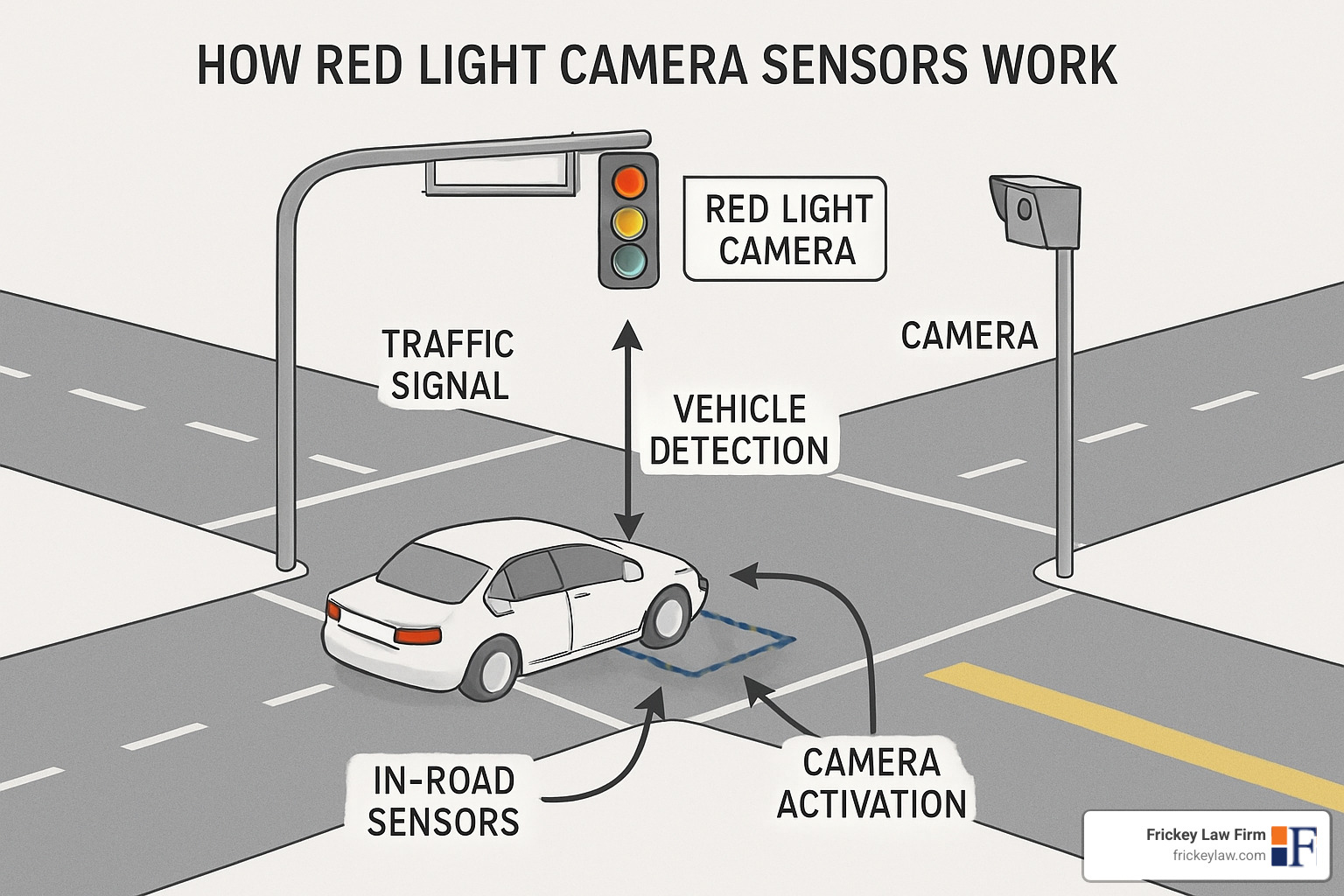
Ever wonder how those silent sentinels at intersections actually catch you? It’s not magic – it’s actually pretty clever engineering. Red light cameras rely on a network of sensors embedded in the road that talk to both the traffic signal and the camera system.
When you approach an intersection, these in-road loops detect your vehicle’s presence. The system patiently waits, monitoring the traffic signal, and only springs into action when the light turns red. Here’s the critical part – there’s typically a 0.3-second grace period after the light changes before the camera activates. This prevents tickets for those “caught in the middle” situations we’ve all experienced.
If your vehicle crosses that white stop line after the light has turned red (and after that brief grace period), the sensors trigger the camera to snap multiple photos. These usually include your car behind the stop line with the red light visible, your vehicle in the intersection while the light is still red, and a close-up of your license plate – creating a pretty comprehensive case against you.
How much is a red light ticket might depend partly on who reviews these photos. In most places, a human officer must verify the violation before a ticket is issued, which helps prevent errors from the automated system. Once confirmed, that dreaded notice finds its way to your mailbox.
Currently, red light cameras are legal in 22 states, while other states have banned or restricted their use. Interestingly, New York City pioneered these systems over two decades ago. According to research from the Insurance Institute for Highway Safety, these cameras have contributed to significant reductions in dangerous T-bone crashes at intersections.
Yellow light timing plays a crucial role in fairness – typically 3 seconds for 30 mph zones and 4 seconds for 40 mph zones. Some drivers have successfully contested tickets by proving the yellow light duration was inadequate for the approach speed.
Finding cameras before they find you
“I never saw the camera until I got the ticket in the mail!” is something we hear often at Frickey Law Firm. Fortunately, most jurisdictions aren’t trying to play “gotcha” with these devices.
Most cities with red light camera programs publish their locations openly. Philadelphia’s Parking Authority, for example, maintains a complete list of all 31 camera-equipped intersections on their website. Similarly, Yonkers, NY provides an interactive Google Map showing the exact placement of their 25 authorized cameras.
If you can’t find a published list, camera installations are public information. You can often obtain location data through simple public records requests to your local transportation department.
Many drivers now rely on navigation apps that include red light camera alerts as part of their traffic warning systems. These can provide helpful reminders to be extra cautious at camera-equipped intersections.
While knowing camera locations might help you avoid tickets, I always remind my clients that the primary goal is safety. Red light cameras are typically installed at intersections with high crash rates, so extra caution at these locations protects both your wallet and your well-being.
Right-on-red rules & special cases
Right turns at red lights generate a surprising number of camera tickets – and plenty of confusion. Let me clear things up.
In all jurisdictions, a complete stop before turning right on red is non-negotiable unless explicitly posted otherwise. Many drivers perform what I call the “rolling pause” – slowing dramatically but never actually stopping. Cameras don’t give points for style; they only recognize a full stop.
Always scan for no-turn-on-red signs at intersections. These restrictions exist for specific safety reasons, often due to limited visibility or pedestrian crossing patterns. Camera systems will flag these violations just as quickly as straight-through red light runs.
Red arrow signals deserve special attention. A red arrow specifically prohibits the indicated movement, even when a right turn would normally be permitted on a regular red light. This distinction trips up many drivers.
School and work zones often come with improved penalties. In Nevada, for example, the standard red light fine of $305 more than doubles to $710 in these designated areas. The rationale is clear – extra protection where vulnerable pedestrians are present.
One final note – even at camera-enforced intersections, an officer can still pull you over and issue a traditional moving violation ticket. In such cases, the camera ticket is typically dismissed in favor of the officer’s citation, but you’re dealing with the more serious consequences we discussed earlier.
If you’re facing confusion about right-on-red rules or need more information about Red Light Violations, our team at Frickey Law can help clarify your specific situation and options.
Conclusion
Let’s face it—seeing those flashing red and blue lights in your rearview mirror or finding that unexpected envelope in your mailbox is never a good feeling. After exploring the ins and outs of how much is a red light ticket across the country, one thing is clear: the financial sting varies dramatically depending on where you are and how you got caught.
Whether you’re facing a $50 camera ticket in New York or staring down a potential $1,000 fine in Nevada, knowledge truly is power. The good news? You now have that knowledge at your fingertips.
How much is a red light ticket isn’t just about the immediate hit to your wallet. Those officer-issued tickets can haunt your driving record and insurance premiums for years to come, while camera tickets typically leave your driving record untouched. This distinction alone can save you hundreds or even thousands of dollars over time.
The 30-day clock starts ticking the moment you receive your ticket, so don’t let it gather dust on your kitchen counter. Each passing day beyond the deadline can pile on additional fees or even escalate to more serious consequences like registration holds.
While paying immediately might seem like the path of least resistance, take a moment to consider your options. Did the camera malfunction? Was the stop line faded? Were you yielding to an emergency vehicle? These and other valid defenses have helped many drivers successfully contest their tickets.
Of course, the best strategy is always prevention. Those red light cameras aren’t installed just to generate revenue—they’re there because intersections with red light cameras see significantly fewer fatal crashes. The momentary convenience of rushing through that yellow light simply isn’t worth the risk to your safety, your record, or your bank account.
Here at The Frickey Law Firm, we’ve guided countless Raleigh residents through the confusion and stress of traffic violations. Our board-certified team understands that each case is unique, and we’re committed to helping you find the most favorable resolution possible—whether that means negotiating reduced penalties or fighting an invalid citation.
Traffic enforcement should ultimately serve public safety, not just municipal budgets. By understanding both your rights and responsibilities on the road, you can make smarter decisions that protect your driving privileges and financial well-being.
If you’ve recently found yourself holding a red light ticket in Raleigh and feeling unsure about your next steps, you don’t have to steer this alone. The Frickey Law Firm’s award-winning team is just a phone call away, ready to put our proven track record to work for you.
More info about red-light ticket help
